

ABOUT SERIGRAPHIC PRINTS

SERIGRAPHS
Serigraphy is a twentieth-century multicolor print-making technique, developed in America. Its first formal introduction as an artist’s technique occurred with an exhibition of serigraphs at the New York World’s Fair in 1939. Since then it has become a widely accepted medium for artist’s original prints.
The method is simple in principle and execution. Serigraphy is basically a stencil process, where the designs are placed upon a piece of fine-mesh silk tacked to a wooden frame, with various film-forming materials used as resists. The wooden frame is about two inches deep and forms a box (with the silk constituting the bottom) within which the ink can be conveniently manipulated with a squeegee. Multiple screens are used to build multiple layers of color that form an image. Although successful serigraphic prints can be made with one screen and one color, almost all of the development work on silk-screen printing as a fine-arts medium has been done with the aim of producing color prints in full unlimited ranges.
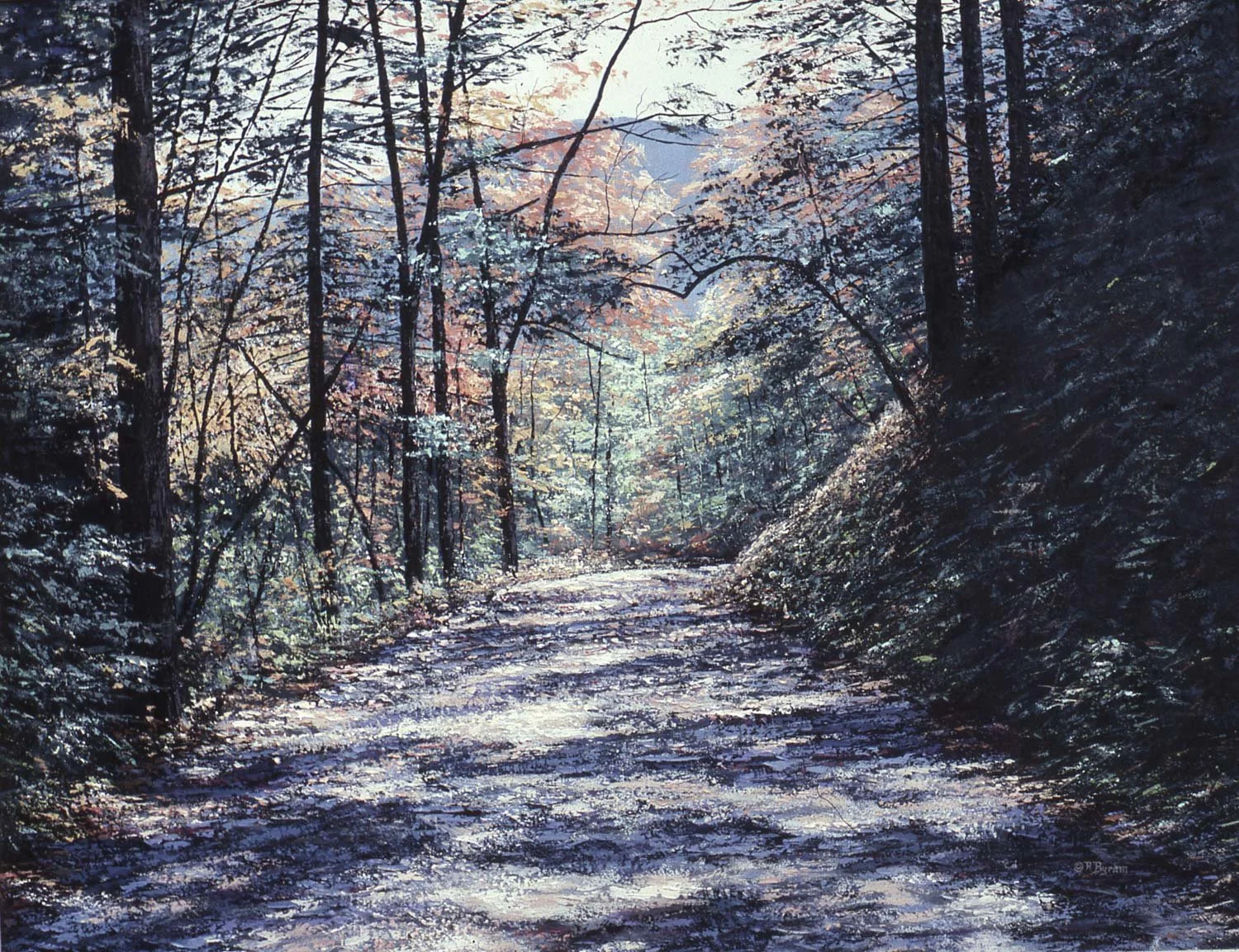
Painting Ray created as a composition and color guide for serigraph.

The finished Serigraph.

Detail from the serigraph above.
IN HIS OWN WORDS
“My serigraphy differs from basic methods in that I create a painting first. Then I carefully plan the exact number of colors I will use in the serigraphic version of the painting. The inks I use are oil based and opaque, and I hand-mix a variety of colors together to get the exact color I want for each screen. To mix a complete set of 16 to 22 inks for an edition takes me 2 or 3 days.
I begin the hand separation process that allows me to print one color at a time, by carefully cutting pieces of clear plastic acetate - creating one separation for each color that will be in my print. It is a conceptually and mentally all encompassing task! I have spent as much as 20 hours on one color separation. The 16 to 22 color separation process takes me anywhere from 7 to 10 weeks per image.
Each separation must then be transferred to the silkscreen boxes. I do this by putting an emulsion on a silk screen and transferring the image from the separation to the screen using a light table (a large glass-topped table with fluorescent lights beneath). I turn on the table lights which burns the emulsion into the screen. Where the red opaque ink is “painted” the light cannot go through, thus in those little spots the emulsion does not get burned in. Then I hose down the screen and the emulsion falls out exactly where the opaque ink was, leaving a clean opening in the screen. That is where the ink can go through the screen onto the paper. I do that with each separation and screen until all the screens are ready for printing.
When printing, I precisely register and hinge the screen to a large table. I lift the screen, set a sheet of paper in, lower the screen to just above the table, and pour the ink in at one end of the screen. The squeegee is pushed across the screen, forcing the ink through the screen in the precise places where I want it to go. After a color is applied, the screen is lifted by a pulley system. The paper, which now has wet ink on it, is removed and placed on a drying rack. I print as many as I wish of one color, then unhinge that screen from the table.
This process is repeated for each color and each sheet in the edition. The used screen is switched out for the next one, the color is changed, and the ink and squeegee process is repeated until each color has been applied to each sheet in the edition.
I print with far more colors than is normally used in the creation of a serigraph. Six to seven colors is a lot. The sixteen to twenty two I use is basically unheard of. My separations and screens are unusually precise, and the details in my prints are extremely crisp and clean. These hand crafted prints are technical masterpieces. They are also very rewarding to create, and allow me to offer limited edition, original artworks to people who love my landscapes - at an affordable price.”
- Ray Byram